
MENU

Effective demand planning and forecasting is critical to aligning asset acquisition with operational needs. The procurement of a new asset should always align with the organisations long term strategic plan and should align with operational and financial goals and targets.
Learn more.svg)
Asset criticality analysis is the process used to assign a criticality rating to assets based on potential risk the business and drives decision making when asset is in service. All new assets should be fit-for-purpose and should be formally risk assessed to ensure it is capable of meeting business objectives safely and efficiently.
Learn moreCapital investment decision making ensures new assets are delivered in budget, on time, and meet business objectives. OPEX (Operating expenditure) and CAPEX (Capital expenditure) should be determined for new assets to ensure cost effectiveness.
Learn moreStrategic sourcing sets the foundation for parts availability and cost control by aligning supplier selection and contract terms with operational needs.
Learn moreEffective procurement ensures timely acquisition of goods and services that meet quality, cost, and schedule requirements. Operations and Maintenance provide demand forecasts and specifications, Supply Chain executes purchase orders and manages vendor relationships, while Finance oversees financial controls and payment processes.
Learn moreEffective procurement ensures timely acquisition of goods and services that meet quality, cost, and schedule requirements. Operations and Maintenance provide demand forecasts and specifications, Supply Chain executes purchase orders and manages vendor relationships, while Finance oversees financial controls and payment processes.
Learn moreOnce the planning for a new asset has been completed, the organisation can proceed with how they will procure the asset (via a tender/contract, or purchase order etc).A critical spares analysis should be carried out to determine risk of extended downtime in the event of an unplanned failure & inventory holdings should be adjusted accordingly.
Learn moreMaintenance activities should be managed within an organisation’s computer system. This ensures historical maintenance data is captured consistently with relevant costs linked to assets. Data captured can be used to analyse performance, allowing decision makers to implement improved maintenance strategies and cost saving initiatives.
Learn moreCommissioning an asset once it has been delivered ensures that it is operating as designed. A handover checklist should be completed prior to operations taking ownership of the asset. Training packages should be developed and operators deemed competent before operating any asset. Operators should also know how to properly conduct a "pre-start" on the equipment.
Learn moreWork management defines the process of ensuring maintenance work is identified, prioritised, planned and executed in a safe, efficient and cost-effective manner. Maintenance works should be scheduled in the ERP following a planning and scheduling process.
Learn moreOverhaul management ensures that major repairs or refurbishments are strategically planned, cost-effective, and aligned with the asset’s operational life. Overhaul management involves making informed decisions on replacement versus refurbishment.
Learn moreOnce an asset is deemed no longer required, the decommissioning and disposal process will commence, bring the asset to the end of its life. An aspect of disposing a tangible asset involves ensuring the computer systems are updated to avoid confusion and data errors.
Learn moreContinuous improvement ensures assets, maintenance practices and management systems evolve to maximise reliability, performance, safety and value throughout the asset lifecycle.
Learn moreCost control maximises value from assets by balancing acquisition, maintenance, operating and disposal costs across the entire asset lifecycle.
Learn moreAsset performance should be analysed through regular KPI and reliability reporting. These insights enable organisations to make informed decisions regarding asset strategies, maintenance investments and lifecycle management.
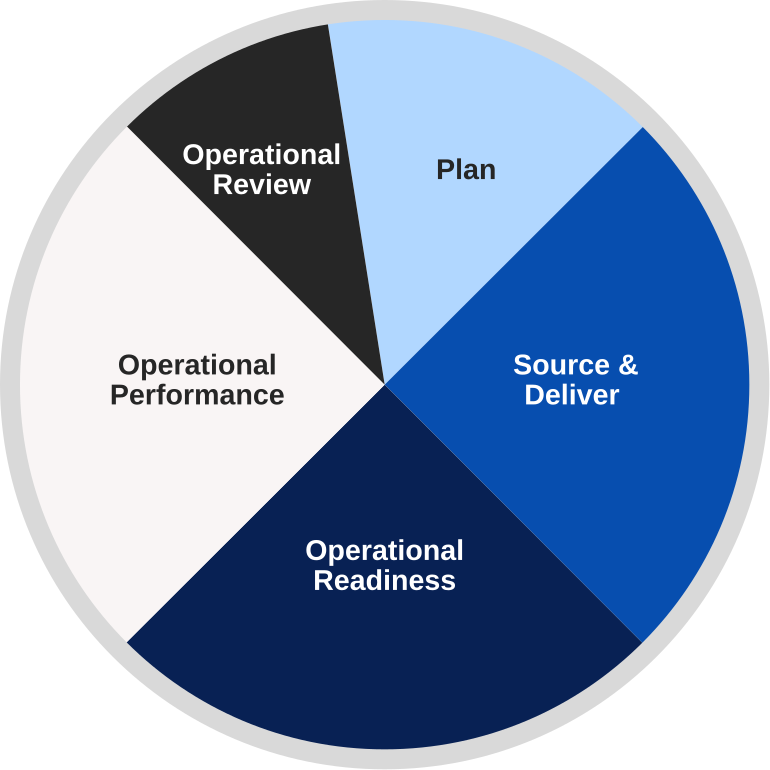
Learn moreClick on an element for more information >>>
"Asset management is the coordinated activity of an organisation to realise value from its assets. It is the systematic and analytical process of acquiring, operating, maintaining, and disposing of assets in the most effective manner - including all costs, risks, and performance attributes."